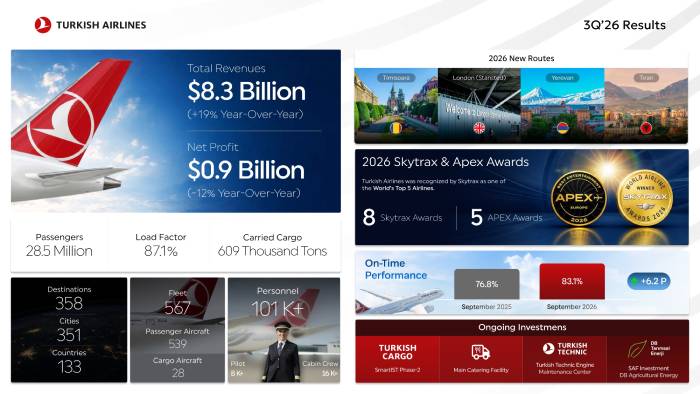
Accelerated by rising geopolitical tensions and increasing energy costs, global inflation continued to weigh on the aviation industry in the third quarter of 2026. While inflationary pressures placed an additional burden on non-fuel expenses, Turkish Airlines’ jet fuel costs increased by 118% since the beginning of the year. Reflecting the impact of the ongoing conflict in the Middle East on demand and operating conditions, Turkish Airlines revised its 10% passenger capacity growth target for 2026 downward, with capacity increasing by 3.2% in the third quarter.

Under these challenging operating conditions, Turkish Airlines sought to mitigate the impact of adverse developments through its flexible business model, extensive flight network and agile capacity management. By directing capacity towards markets with strong demand dynamics, Turkish Airlines maintained its position as Europe’s leading network carrier by number of flights and increased passenger numbers and load factors in the third quarter. During the July–September 2026 period, passenger load factor increased by 1.5 percentage points year-on-year to 87.1%, while passenger numbers rose by 4.7% to 28.5 million.
Strong growth in passenger and cargo revenues partially balanced the impact of rising costs on financial results. Total Revenues increased by 19.3% year-on-year to USD 8.3 billion in the third quarter. Leveraging its strong infrastructure and strategic location, Turkish Cargo increased cargo volume by 7.4%, while cargo revenues rose by 45.6% to more than USD 1.2 billion. However, the significant increase in costs, particularly jet fuel expenses, outpaced revenue growth and negatively affected operating profitability. To limit this impact, flag carrier focused on efficiency initiatives while selectively reviewing its investment plans. Supported by these measures, EBITDAR amounted to USD 3.7 billion in the first nine months of the year, while the EBITDAR margin declined by 6.2 percentage points year-on-year to 17.6%.