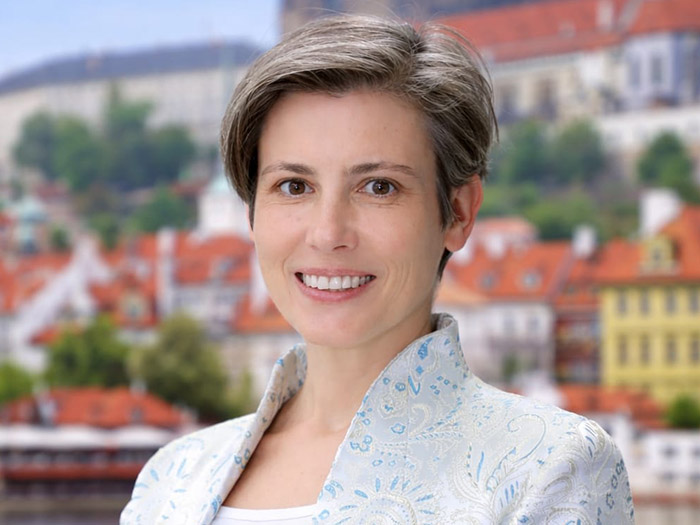
Barbara Andelova is a Czech Tourism Marketer and International Communications professional working across destination promotion, media, culture and entertainment. Based in Prague, she studied at Jawaharlal Nehru University (JNU) in New Delhi, an experience that helped shape her long-standing connection with India and understanding of the region.
In her role at Czech Tourism, she works closely with Czech diplomatic missions abroad and trade partners, particularly across India and the GCC countries, promoting Czechia and developing international partnerships. Her recent work has included the launch of Jazeera Airways winter flights connecting Kuwait and Prague, alongside initiatives linking tourism, aviation and international markets.
Her activities have also expanded into the entertainment sector through collaboration with Punjabi artist Diljit Dosanjh and his team, further strengthening her role in connecting Czechia with India through tourism, culture and the creative industries.
We caught up with Barbara Andelova and she shared her thoughts about various issues as under;
She informed us that there is a huge impact, a really huge impact. Arabic clients from certain GCC countries, like Saudi Arabia and Kuwait, depend on direct flights. The direct flights from Kuwait with Jazira, and from Saudi Arabia with Flynas and Flywheel, are only seasonal, only during the summer months. Right now we're in September, so we don't have any direct flights anymore, and partners in Czechia actually lost the whole season with clients from this region.
Of course, the UAE and Qatar have several direct flights a day, but during the disruption and uncertainty around connectivity, even with direct flights available, people were scared to travel abroad. Obviously, if you don't know what can happen in a few days, whether you might get stuck in another destination, or when you'll be able to return home, that changes things. So the season wasn't very good for Czech tourism, for the numbers, for the hotels and restaurants, and for the travel business all around. But when we looked at the statistics after summer, we saw the drop was only around 30%, maybe a bit more. Compared to neighbouring countries, some European countries were impacted by 50% or more, so from that perspective it wasn't so bad. Still, this year was a challenge, and I hope it will keep picking up, it's already picking up slowly. Every year we normally see an increase of around 17% in clients from the GCC region, so we want to get back to that trend. I hope it will be fine, but we're living in a region where everything can change from one day to the next.
Looking ahead to 2027, Barbara said that Czech Tourism is actually following a five-year marketing and strategy plan, so right now we have a plan that runs from 2026 to 2030. This year and next year we're following a theme: feel free to be amazed in Czechia, feel free to be surprised, feel free to try, to taste, feel free to laugh, just to be yourself. You can see the poster over there too, and we'll keep this theme for next year as well. We're not promoting Prague itself, that's really the business of Prague City Tourism. But central Prague, the whole city, is already crowded with tourism, so even when we do media or influencer campaigns, we show another side of Prague, different parts of the city. For example, Olišovice, which is Prague 7, quite a new district, full of street art, theatres, music clubs, great restaurants, and open spaces.
Barbara further said regarding the food scene in the country that there is also great street food, which is what makes it interesting. You're there with locals, a great atmosphere, interesting places. It's not historic like the Old Town, but you feel free to just sit in the park or in a nice open space where there's a restaurant or a food street and relax.
Barbara said that the country has some very interesting exhibitions, I don't want to call them museums exactly, but for example the Signal Festival is quite famous. It's a festival of lights, done through video mapping and projected onto certain places around Prague. The technology is very advanced, and tech companies from abroad come because they want to cooperate on it. They've also opened a space that's like an interactive museum, where you can go and experience a different atmosphere, playing with the lights and the technology.
Gastronomy is another important thing. We have a Michelin Guide for Czechia now, a Michelin of Czech cuisine, which was released in 2025. Another revision is coming, I think in November or December 2026, so we'll have more Michelin-starred restaurants. We're also trying to get Czech cuisine, Czech gastronomy, onto the UNESCO heritage list, because it's special, it's precious.
Karlovy Vary, the spa region, everyone knows that one. Everyone wants to go there, press, influencers, tour operators. We still take them, but we're not showing them Karlovy Vary itself anymore. We show them what's around the Karlovy Vary region, where to go for nature and other experiences. Germany is right next door too, so it's easy to cross the border. It's not just about the city or the spa.
For us, it makes sense to promote the north of Czechia, places like Konoshe and the Tisza Walls region, Czech Switzerland. Beautiful nature, not many tourists so far, lots of activities for families, for kids, for youngsters, like adventure parks. The infrastructure is there too: hotels, chalets, so an Arabic family can rent a whole chalet, sometimes with services, sometimes without.
It's also on the way to Berlin, so it makes sense to stop there and spend an extra night or two. Or heading towards Austria, around Český Krunov in south Bohemia, not Český Krunov itself, which is also a unique place, but what's around it. There's Hluboká Castle, a wonderful place, and there's Třeboň, Třeboňsko, a UNESCO area with an artificial pond system. It's a huge, special system of ponds, maybe 200 to 400 years old, though I'd need to check the exact dates.